Plan ahead Commercial · Waterford
Master Key System Design in Waterford
The office key ring has become the org chart. Every manager carries a fistful of cuts, a couple of staff hold copies nobody remembers issuing, and when someone asks which key opens the records room, three different people give three different answers.
Call now · open 24/7(226) 641-0178In plain words
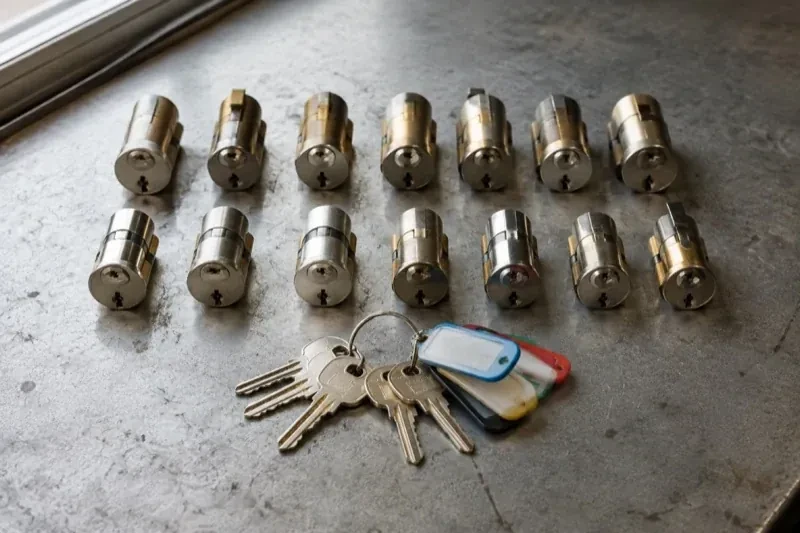
Master key system design is the work of turning a property's separate locks into one coherent hierarchy: a change key for an individual door, a sub-master over a department or floor, and one top-level master reserved for the few people who need it. The locksmith records who should open what, matches that list to the cylinders already installed or to new ones chosen for the job, and pins every lock so each key opens exactly its intended group. The finished system comes with a chart the owner controls, so access follows the organization instead of following whoever happened to be handed a spare key.
How the visit goesA property manager taking over a small commercial building inherits a shoebox of keys with no labels and no chart. Some open the mechanical room, some open vacant units, and a few do not seem to match anything currently on the property at all.
Master Key System Design · Waterford
How the visit goes
- 1
Room to grow before it is needed
The assessment asks about plans the business already has in mind: a leased unit expected to fill, a department likely to split in two, a location due to open next year. Building spare capacity into the keying platform now is far simpler than adding a level to a system that is already fully pinned, which can mean touching cylinders that were never meant to change. This forward-looking check shapes which keying platform and how many reserved combinations the design settles on before any cylinder is committed to a specific level.
- 2
Building the hierarchy from the bottom up
Design starts with the smallest unit, the individual change key, and works upward. Each door that stands alone gets its own combination; doors that should share access are grouped under a sub-master; and a single top-level master is reserved for the short list agreed earlier. Building in this order keeps the levels honest, since a sub-master or master is only created where a real group of doors justifies it, rather than being added because it seems useful in the abstract. The result is a hierarchy that matches the organization rather than one imposed on top of it.
- 3
Care that keeps the hierarchy intact
A little routine care keeps a master key system working the way it was designed. Cylinders should get whichever lubricant the cylinder maker actually recommends, since that varies by manufacturer and some rule out graphite while others call for a light oil, and a key that starts needing a wiggle is worth attention before it is forced or breaks off. None of this maintenance touches the pinning itself, so the hierarchy stays exactly as documented on the chart through years of ordinary use.
In the van
- Cylinder decoders
- Keying chart
- Restricted or standard key blanks
- Change and master keys
- Compatible replacement cylinders
What affects the quote
- 1
How many locations are involved
A single building is simpler to assess and pin than several sites intended to share related levels of access. Travel between locations, and keeping the hierarchy consistent across more than one property, both add to the overall scope of the project.
- 2
Administrator training and handover time
Walking the named administrator through the chart, the issuance process and how to handle a future lost key or new hire takes a defined amount of time on the day of handover, and a more detailed walkthrough for a larger, multi-level system takes longer than a simple one.
- 3
Collecting and retiring old keys
Gathering up old keys that are being replaced, confirming they no longer operate any cylinder, and retiring them from circulation is a small additional step some businesses want included, separate from the core design and cutting work.
Same fees day, night or weekend.
Master Key System Design: questions
What happens if a master-level key goes missing?
The current chart shows exactly which doors that level was designed to reach, which for a lost top-level master can mean the whole property rather than one group. Depending on how the key was lost and who else already holds that level, the usual options are repinning the affected cylinders and reissuing keys to the remaining holders; a restricted keyway lowers the odds of an unauthorized copy being cut but is not proof that one has not been made. Without a current chart, the first task is reconstructing that scope.
Can my existing locks be used, or do I need all new hardware?
Many existing cylinders can join a new hierarchy as they are, once their keyway and condition are confirmed compatible. Others, particularly older or mismatched hardware, are replaced so the whole system pins cleanly without cross-keying. The assessment identifies which doors fall into each group before any work begins, so the plan reflects what is actually on the property rather than assuming everything needs to change.
How is the key chart kept private?
The chart is handed to a named administrator rather than left as loose paperwork, and it is stored somewhere only that person can reach, separate from day-to-day office records. It is not published, circulated widely or kept alongside general building documents. When the administrator role changes hands, custody of the chart moves with a signed acknowledgement rather than being passed along informally.
Master Key System Design near you
Haldimand-Norfolk, Ontario
Waterford information
- Town
- Waterford, Haldimand-Norfolk, Ontario
- In business
- 22 years
- Hours
- Open 24/7 · nights, weekends and holidays, same fees
- Phone
- (226) 641-0178
- Visits
- On-site assessment preferred. Request a visit or call.
What the census means at the door
62%
Older homes. About 62% of homes in Norfolk County were built in 1980 or earlier, according to the 2021 Census.
Older doors are usually thicker and made of solid wood, which is good news. They take a deadbolt well, hold longer strike screws, and reward reinforcement. The locksmith measures the thickness and backset so new hardware fits without fresh holes.
83%
Mostly houses. Single-detached houses make up about 83% of homes in Norfolk County (2021 Census).
Where homes are mostly detached, patio and sliding doors deserve attention alongside the hinged ones. Auxiliary locks, pin locks and better latches for sliders are routine additions that a locksmith brings on the same visit as the front door work.
Nearby
Open 24/7
Request a visit
The office key ring has become the org chart.
Call now · open 24/7(226) 641-0178- On-site assessment preferred
- Same fees day, night or weekend
- 22 years in business